Insights Sorting
Cluster findings into named insights that carry a tension.
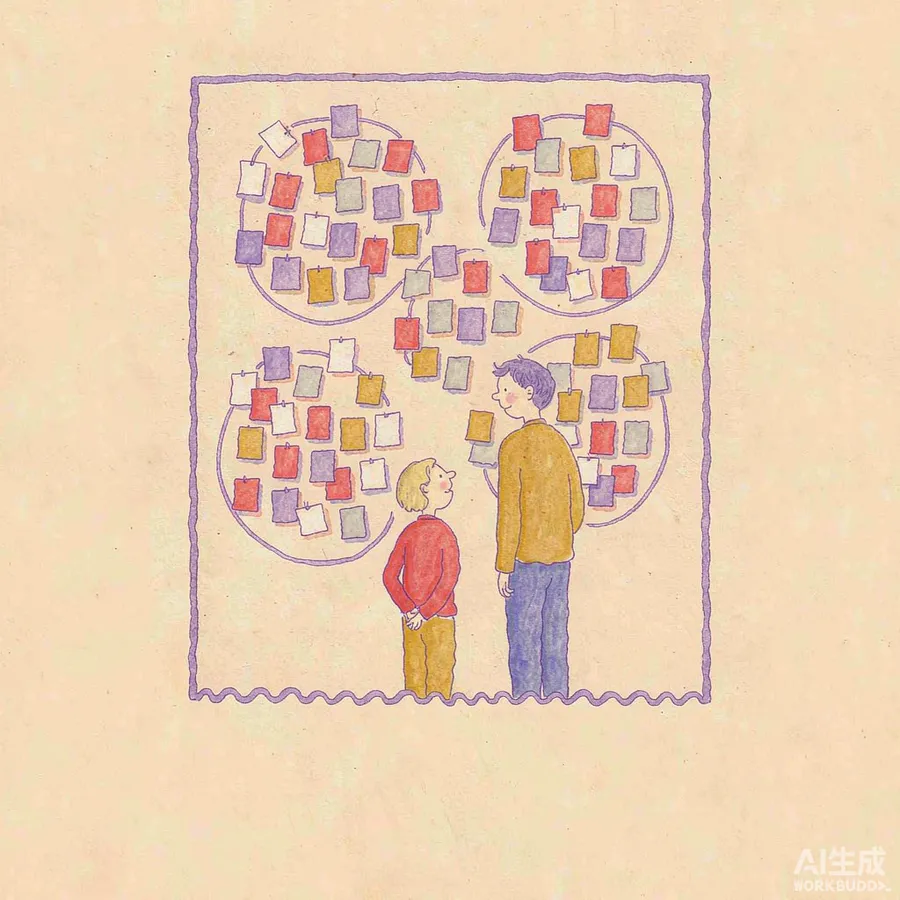
Each finding on its own card, sorted into clusters, each cluster named as an insight. The name is the work: it has to say something the raw findings do not.
Time
2 hours
Group
3-6
Output
Named insight clusters
Move
Synthesize
Run sheet
How to run it
4 steps · 2 hours
- 01
Write each finding on a card
- 02
Sort them into clusters
- 03
Name each cluster as an insight
- 04
Test it against the evidence
Say this
Lines you can read out as they are — no improvising under pressure.
“What do these have in common that the others do not?”
“What would you call this if you had to defend the name?”
“Which card belongs nowhere?”
Set up
Before they walk in
- □One finding per card, in the participant's words where possible
- □A large wall
- □A rule that a cluster needs at least three cards
What to watch for
Signals and traps
It is working when
- a cluster name makes someone in the room uncomfortable
It usually fails when
- clusters named after the research questions
- cards placed by topic rather than by meaning
If it stalls, or the room is the wrong size
Variations
Sort silently first, talk second
Sort twice with a break between
Give the outliers their own wall
Background
Where it comes from
From Kumar's 101 Design Methods, related to the affinity diagram developed by Jiro Kawakita. Clustering is fast and satisfying, which is exactly why the naming step gets skipped and the wall becomes a tidier version of the transcript.
Cautions
When it does more harm than good
- One finding per card or the sort is meaningless
- A cluster name that describes its contents has not yet produced an insight
- Check every insight against at least two pieces of evidence
When to use
Reach for it when…
After research and before ideation
The data feels like a pile
Source
Kumar, V. (2012). 101 Design Methods: A Structured Approach for Driving Innovation in Your Organization. John Wiley & Sons.
Source phase: Analysis (Kumar). Steps and the run sheet are written for this library, not quoted from the source.