Image Sorting
Sort images to reveal the categories people actually use.
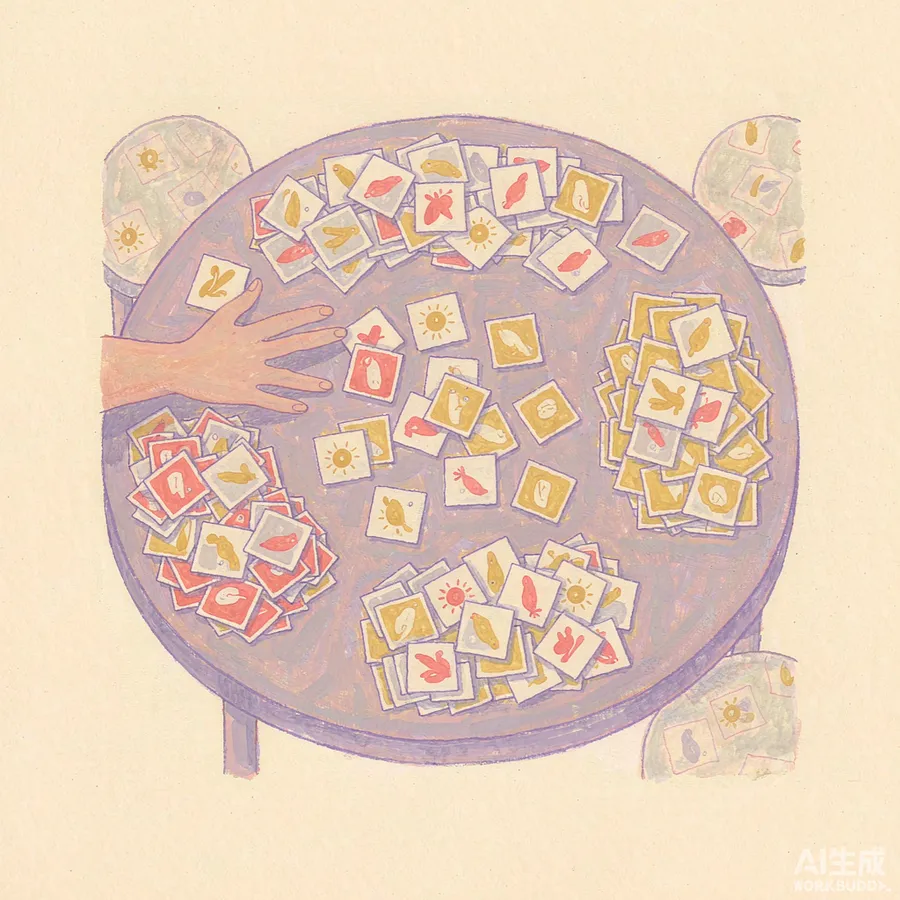
Participants group a set of images and explain the logic of the groups. It surfaces categories people use without being able to name them.
Time
45-60 min
Group
1-2
Output
Category maps and rationale
Move
Synthesize
Run sheet
How to run it
4 steps · 45-60 min
- 01
Prepare a diverse image set
- 02
Ask participants to group them
- 03
Ask for the logic behind the groups
- 04
Compare across participants
Say this
Lines you can read out as they are — no improvising under pressure.
“Why do these belong together?”
“Which image does not fit anywhere?”
“What would you call this group if you had to name it?”
Set up
Before they walk in
- □Forty to sixty images covering the range, including a few odd ones
- □A large table
- □A way to record the groups, by photo or by grid
What to watch for
Signals and traps
It is working when
- two participants group the same images completely differently
It usually fails when
- an image set drawn only from your own category
- groups left unnamed
If it stalls, or the room is the wrong size
Variations
Sort by feeling rather than by function
Sort twice, before and after a discussion
Leave the images on a workshop wall and let the room re-sort them
Background
Where it comes from
From Kumar's 101 Design Methods, related to card sorting and to the pile-sorting tradition in anthropology. Images reach for categories that vocabulary misses, and comparing the group logic across participants is more informative than any single sort.
Cautions
When it does more harm than good
- The image set is the instrument, so a biased set produces a biased map
- Ask for the reason behind each grouping, not only the grouping
- Do not average the sorts into one map — show the disagreements
When to use
Reach for it when…
You need mental models
Language is limiting
Source
Kumar, V. (2012). 101 Design Methods: A Structured Approach for Driving Innovation in Your Organization. John Wiley & Sons.
Source phase: Exploration (Kumar). Steps and the run sheet are written for this library, not quoted from the source.